

Uncategorized

social media marketing
DIgital marketing

Social Media Marketing as a Human Connection Engine

Social Media Marketing as a Human Connection Engine    The Algorithmic Shift: Beyond the Follower Count The algorithmic shift over the past few years has fundamentally changed how content visibility works. Traditional chronological feeds have been replaced by machine-learning-driven “interest graphs.” This means your content is not necessarily shown to the people who follow you, but to the people the algorithm predicts will find it meaningful.  Stop writing exclusively for your existing audience; start creating for the specific search intent and retention metrics of your future audience.  The currency today is not the follower; it is the “share” and the “save.”  If your content doesn’t hold attention immediately, the platform will restrict its distribution, regardless of your follower count.  The Rise of Raw, High-Velocity Video A dominant trend cementing this reality is the transition from polished, studio-quality production to raw, high-velocity video. Short-form vertical video remains the primary growth lever across Instagram Reels, TikTok, and YouTube Shorts.  The key to longevity is “edutainment”—a blend of education and entertainment.  Winning brands don’t just dance to trends; they use trending audio formats to explain complex industry concepts or demonstrate product use cases in three seconds or less. The hook rate in the first 0.5 seconds of a video has become the single most critical metric for organic reach, overtaking even the click-through rate. The Collapse of the Traditional Sales Funnel Simultaneously, we are witnessing the active dismantling of the sales funnel as we know it. The path from discovery to purchase is no longer linear. Social commerce has collapsed the funnel into a single, instant moment.  Native in-app checkout and live shopping streams allow users to make immediate buying decisions without ever leaving the distraction-free environment of the app.  Every single piece of content must carry discreet but clear transactional potential.  Master the subtle art of “passive selling,” where a product is woven so seamlessly into a lifestyle narrative that the viewer organically asks, “Where can I get this?” rather than feeling subjected to a hard pitch. Social Listening: The Unsung Hero of Engagement The infrastructure of engagement has a quiet, unsung hero: social listening and responsive customer care. The comment section has evolved into the world’s largest focus group.  More than 70% of users now expect a response to a query or complaint on social media within 24 hours.  Move from reactive troubleshooting to proactive conversational marketing to capture unshakeable loyalty.  A clever reply pinned to the top of a post can generate more media mileage than a paid ad campaign, humanizing the corporate entity and signaling healthy comment-to-post ratios to the algorithm. The Power Shift to Micro-Influencers The strategic potential of micro-influencers has eclipsed the era of heavy-spending celebrity endorsements. Creators with audiences between 1,000 and 10,000 followers often yield a 60% higher engagement rate than macro-influencers due to their tight-knit, high-trust community structures.  The modern definition of influence is not reach, but the power to drive an action.  A recommendation from a trusted micro-creator functions as a digital word-of-mouth referral.  The long-term strategy lies in turning these creators into genuine affiliates, granting them creative freedom to tell your brand story in their vernacular to ensure the message remains truly native to the platform. Core fundamentals like consistent voice, visual cohesion, and call-to-action strategy remain important, but they are hygiene factors. The seismic difference between a stagnant social presence and a thriving community now hinges on an obsessive focus on the value exchange. Before you post, you must ask: Does this induce a genuine emotional reaction, or does it simply add to the noise?
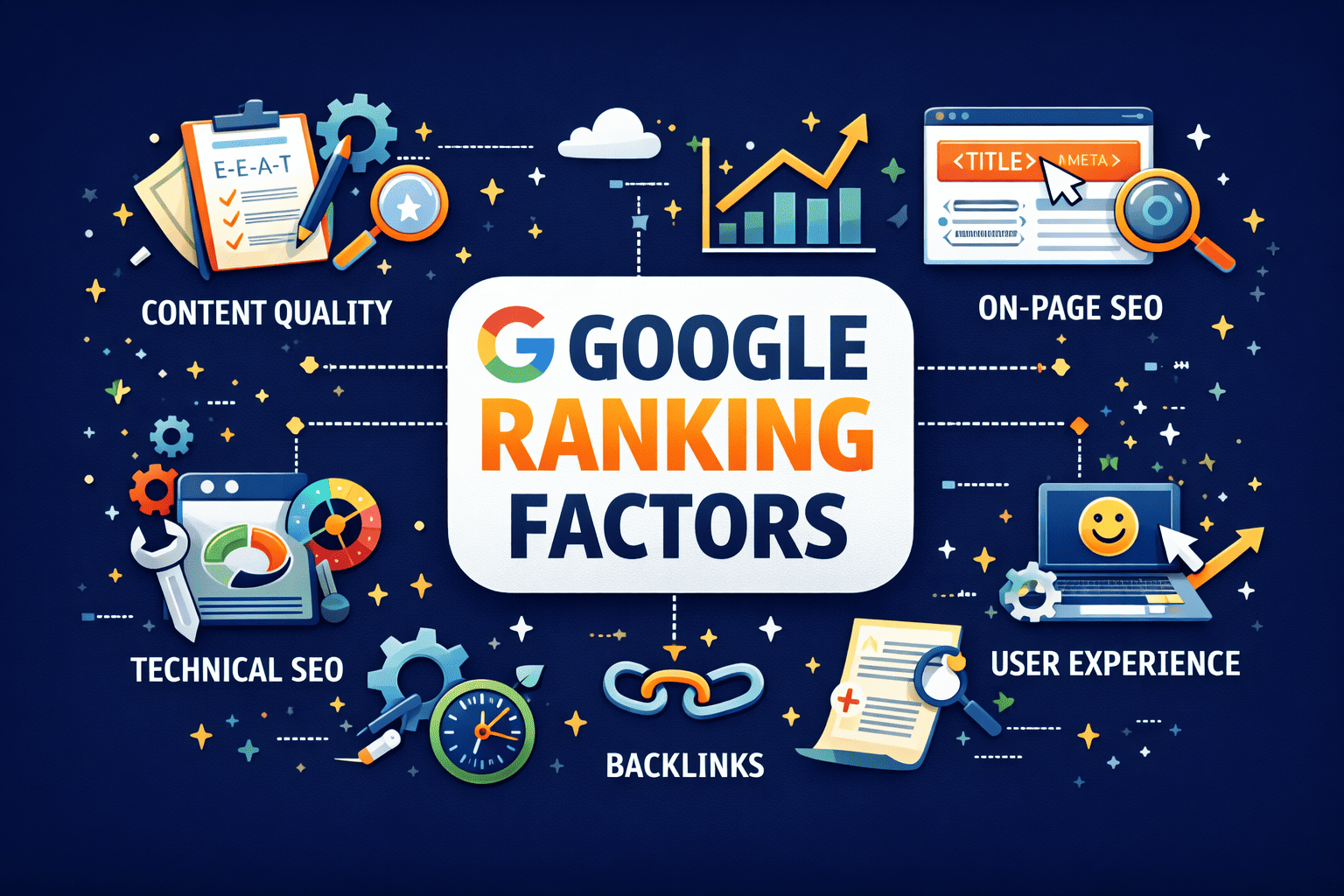
What Are Google Ranking Factors? Your Clear Guide to How Search Works
Uncategorized

What Are Google Ranking Factors? Your Clear Guide to How Search Works

What Are Google Ranking Factors? Your Clear Guide to How Search Works Have you ever wondered how Google decides which website gets the coveted top spot when you hit “search”? One moment you’re asking a question, and the next, Google serves up a neat list of links. It feels almost magical. But behind that simple search box is a complex set of rules and signals—a recipe, if you will. That recipe is made up of Google ranking factors. One way to think about this is, Google’s stated objective is to organize all of the world’s information and make that information accessible and helpful for everyone, everywhere in the world. To accomplish its mission in a fair way, Google needs to have an objective, consistent system for ranking the billions of pages on the web, which it determines by using many different ranking factors. By understanding the various elements that Google uses to rank web pages, the goal is not necessarily to “game” the system or find a way to “trick” Google into favoring your website; instead, the goal is to align your website with what Google believes to be genuinely helpful to your audience. What Are Google Ranking Factors, Really? In simple terms, Google ranking factors are the specific criteria and signals that Google’s algorithms use to evaluate and rank web pages in its search engine results pages (SERPs). The numerous factors indicate to Google a page to be best suited to provide an answer to that user’s search query for any specific keyword or subject The various rank evaluation factors are controlled by Google’s algorithm (Rank Brain and now part of the MUM and BERT ecosystem) in a relative format of hundreds of thousands of rank criteria. No one knows exactly what weighs most heavily in the Google ranking equation, as they would consider the specific algorithm recipes highly classified. However, based on years of use, official communications from Google and independent studies of the search engine industry all lead to a reasonably precise understanding of what is most significant in ranking results. Main Categories of Ranking Factors In order to identify the main factors for a good overall SEO strategy, they can be put together into groups of pillars. SEO experts and professionals frequently refer to these as “Core Pillars for Successful SEO 1. Content Quality & Relevance (The King) This is the non-negotiable foundation. Google’s primary thing is to connect stoners with the most stylish possible answer to their question. E-E-A-T: While not a direct ranking factor, Experience, moxie, Authoritativeness, and responsibility complement Google’s quality evaluation. Comprehensive Coverage : runners that completely explain a content( frequently called pillar content) tend to rank better. Search Intent:  You must match what the user wants — learn, buy, or navigate. Example:For “ how to tie a tie, ” Google prioritizes video tutorials because visual literacy stylishly satisfies user intent. 2. On-Page SEO Factors (Your Page’s Blueprint) These are the rudiments on your website you control directly. Title Tags (H1):  Clear, keyword- concentrated, and under 60 characters Meta Descriptions: Ameliorate click- through rate Header Tags (H2, H3):  Logical structure and better readability Keyword Usage: Natural placement of primary and affiliated keywords Image Optimization: Descriptive filenames and alt text URL Structure: Clean and readable URLs   3. Technical SEO (The Foundation) If your site struggles technically, rankings suffer—no matter how good the content is. Page Speed & Core Web Vitals (LCP, CLS, INP)   Mobile-Friendliness (Mobile-First Indexing)   HTTPS Security   Crawlability & Indexing (sitemaps, robots.txt)   4. Backlinks (The Vote of Confidence) Backlinks are one of Google’s strongest trust signals. Quality > Quantity: One authoritative link beats hundreds of low-quality ones   Anchor Text: Natural and relevant text helps Google understand context 5. User Experience (UX) & Engagement Signals Google observes how users behave on your page. Click-Through Rate (CTR)   Dwell Time & Bounce Rate   Easy Navigation & Clear Layout   Good UX tells Google your page actually satisfies users. Practical Tips to Optimize for Key Ranking Factors Analyze Search Intent first   Create deeper, better content than competitors   Optimize titles, headers, and images   Fix technical issues using Search Console & PageSpeed Insights   Earn backlinks through value, not shortcuts   Myths & Misconceptions About Ranking Factors Myth: There’s a fixed ranking factors list   Myth: Social media likes directly affect rankings   Myth: Only #1 ranking matters   Truth: SEO success comes from consistency, relevance, and quality across many keywords. Conclusion: It’s About Alignment, Not Manipulation So, what are Google ranking factors? They are Google’s way of rewarding websites that deliver the best user experience—useful content, fast performance, strong trust signals, and smooth usability. Instead of chasing algorithms, focus on people. When you build genuinely helpful content on a technically sound website, you naturally align with Google’s ranking systems. Start today: Audit one important page, improve its speed, refine the content, and optimize its title. Small, consistent improvements based on these key SEO ranking signals will lead to long-term visibility and growth Are you ready to take My service? We at The Gardeny are proud to offer carefully designed landscapes crafted to suit our commercial clients’ preferences while prioritizing sustainability. GET IN

Difference Between SEO (Search Engine Optimization) and GEO (Generative Engine Optimization)
DIgital marketing

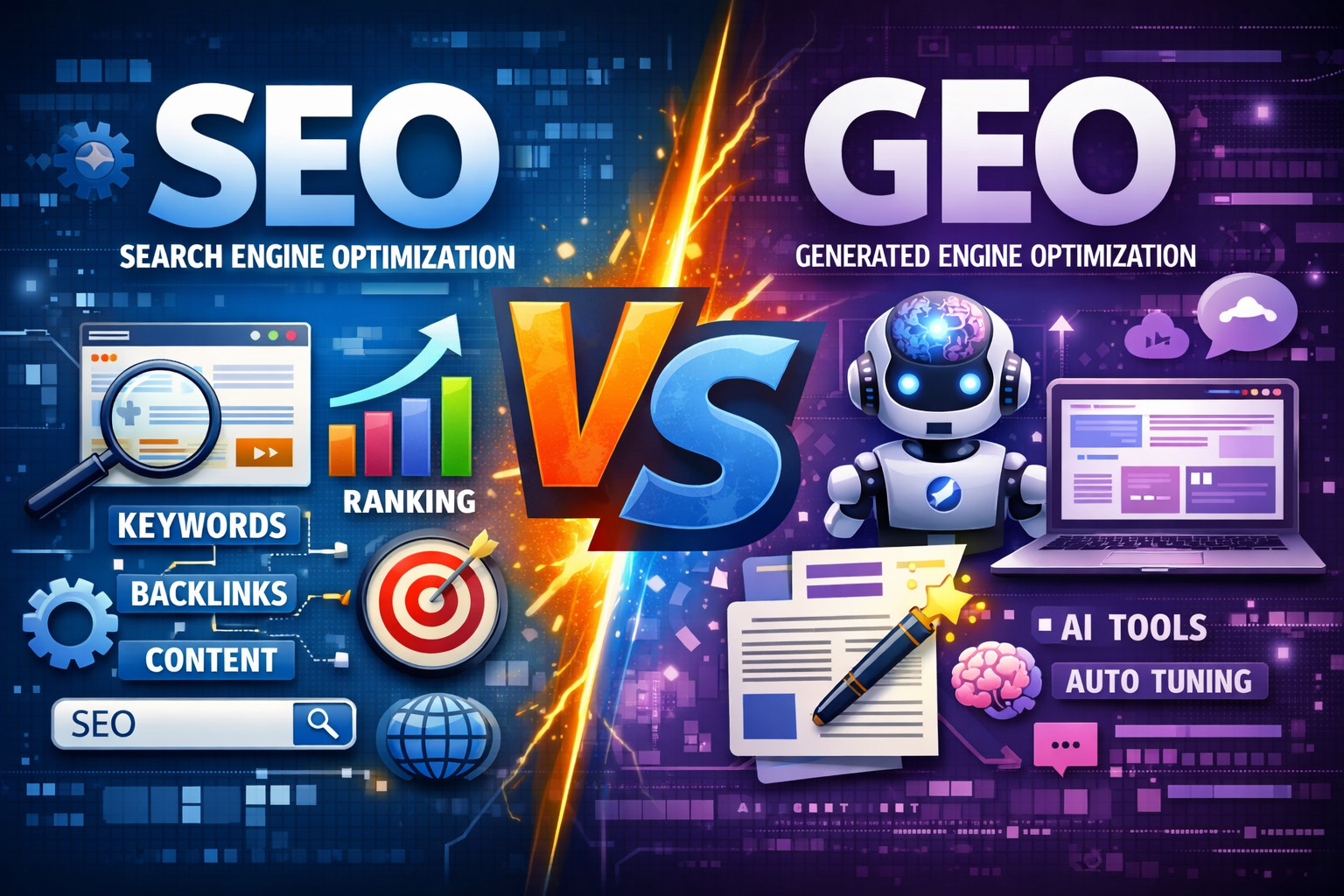
Difference Between SEO (Search Engine Optimization) and GEO (Generative Engine Optimization)

Difference Between SEO (Search Engine Optimization) and GEO (Generative Engine Optimization) People are finding information online faster and in more unpredictable ways than ever before. For years, Search Engine Optimization, or SEO, has sat at the core of online visibility. Now, a fresh concept joins it: Generative Engine Optimization, or GEO. GEO aims at crafting content for AI-driven generative tools such as ChatGPT, Gemini, Copilot, and other big language models, LLMs. People are chancing information online briskly and in further changeable ways than ever ahead. For times, Search Machine Optimization, or SEO, has sat at the core of online visibility. Now, a fresh conception joins it Generative Machine Optimization, or GEO. GEO aims at casting content for AI- driven generative tools similar as ChatGPT, Gemini, Copilot, and other big language models, LLMs. 1. What is SEO (Search Engine Optimization) ? In summary, it’s the practice of optimization of Web pages to enable them to rank higher in search engines such as Google and Bing. 1.1 Core Purpose of SEO Assist people in finding web pages through their search queries Increase organic search engine traffic Improving visibility on Search Engine Result Pages (SERP) 1.2 How SEO Works Search engines use their algorithms to rank Web pages on the basis of several criteria: Keywords and what the user really searches for Quality & Relevance of Content  Links from other sites, and overall authority Technological factors such as page speed and mobile friendliness Signals about user experience 1.3 Key SEO Elements On-page SEO Title tags Meta descriptions Headings (H1, H2, H3) Keyword optimization Off-page SEO Backlinks Brand mentions Technical SEO Site speed Crawling  Indexing 2. What is GEO (Generative Engine Optimization)? GEO is a matter of putting information into shape so that AI-driven generative algorithms can understand it, believe it, and cite it within their responses,” Boyd notes. In contrast to just ranking web pages, GEO is interested in creating content that is: Quoted Summarized Recommended Cited 2.1 Core Purpose of GEO In AI-generated answers, improve readability as some parts are not very understandable. Position content as a trusted source for LLMs Influence how AI explains a topic to users 2.2 How GEO Works Generative engines test:  Clarity of content and structure Factual accuracy Authority and expertise Depth of context Nature of language use Since GEO  unlike SEO, does not depend much on backlinks or the exact matching of keywords. 3. GEO versus SEO: What’s the Difference? 3.1 Primary Objectives SEO:  Search Engine Pages Ranks GEO: Get content utilized in the AI responses 3.2 Output Formats SEO: Blue Links, Featured Snippets, Rich Result GEO: Answers in conversations, summaries, explanations 3.3 Optimization Focus SEO: Keywords, links, and other technical factors GEO:  Meaning, context, and the level of answer quality 4. Comparison Table: GEO vs SEO 1. Target Platform SEO: Google, Bing, And Yahoo GEO: ChatGPT, Gemini, Copilot, And Perplexity 2. User Interaction SEO: The users click on the links GEO: The users read the answers straightaway 3. Ranking Factors SEO: Algorithms, backlinks, and CTR GEO: Semantic relevance, and trust, and expertise 4. Content Style SEO: Scannable and keyword-focused GEO: Conversational and explanatory 5. Metrics of measurement SEO: number of impressions, clicks, search engine rankings  GEO: number of mentions, citations, and the opportunity to be included in responses 5. Content Structure Differences 5.1 SEO-Friendly Content Paragraphs that are of a short length Headings that contain keywords Metadata that is optimized Links to other pages within the same website 5.2 GEO-Friendly Content Definitions that are clear Explanations that are step-by-step Lists in bullet points and numbers Questions and answers that use natural language 6. Keyword Strategy: SEO vs GEO 6.1 SEO Keywords Exact-match keywords Long-tail keywords Search volume–based targeting 6.2 GEO Language Optimization Natural questions (Who, What, Why, How) Entity-based language Context-rich explanations 7. Role of Authority and Trust 7.1 In SEO Domain authority High-authority site backlinks consistency in publishing 7.2 In GEO Clear authorship Information that is accurate and updated. Demonstrated expertise Explanations that are well-structured. 8. Managing User Intent 1. SEO Intent to Gain Information Intent to Get Directions Intent to Complete Transaction 2. GEO Questions Asked to Get to the Point Questions Asked to Find Terms Questions Asked to Decide on a Plan of Action 9. Factors 9.1 Technical SEO Factors Speed of loading the page Adaptability to mobile devices Marking up with schema Sitemaps in XML 9.2 Technical Considerations in GEO Well-structured HTML Headings with semantics Enterprise schema Content that can be easily parsed 10. Content Examples SEO Example Blog posts done with keywords  Emphasis on the position of ranking  At the end, a call-to-action to click on links GEO Example Straightforward replies to inquiries  Neutral tone AI-friendly organized narrations Is it Possible for GEO to Replace SEO? The presence of SEO is still considered a necessity for the traffic of the site GEO is a must for getting AI seen The two are different ways of getting discovered The best strategy is the one where SEO is mixed with GEO. Future of Digital Optimization The search powered by AI is on the rise Growing are zero-click searches The generative answers make the link dependency lower Companies or brands will have to optimize for both humans and AI Final Thoughts SEO is a tool that leads people to your website. GEO is a tool that lets AI showcase your knowledge. To remain competitive in 2025 and later: Continue with strong SEO Begin optimizing for GEO Produce quality, structured, trustworthy content By discerning the differences between GEO and SEO, companies and marketers can devise a digital strategy that is ready for the future and works on search engines as well as generative AI platforms.

Scroll to Top